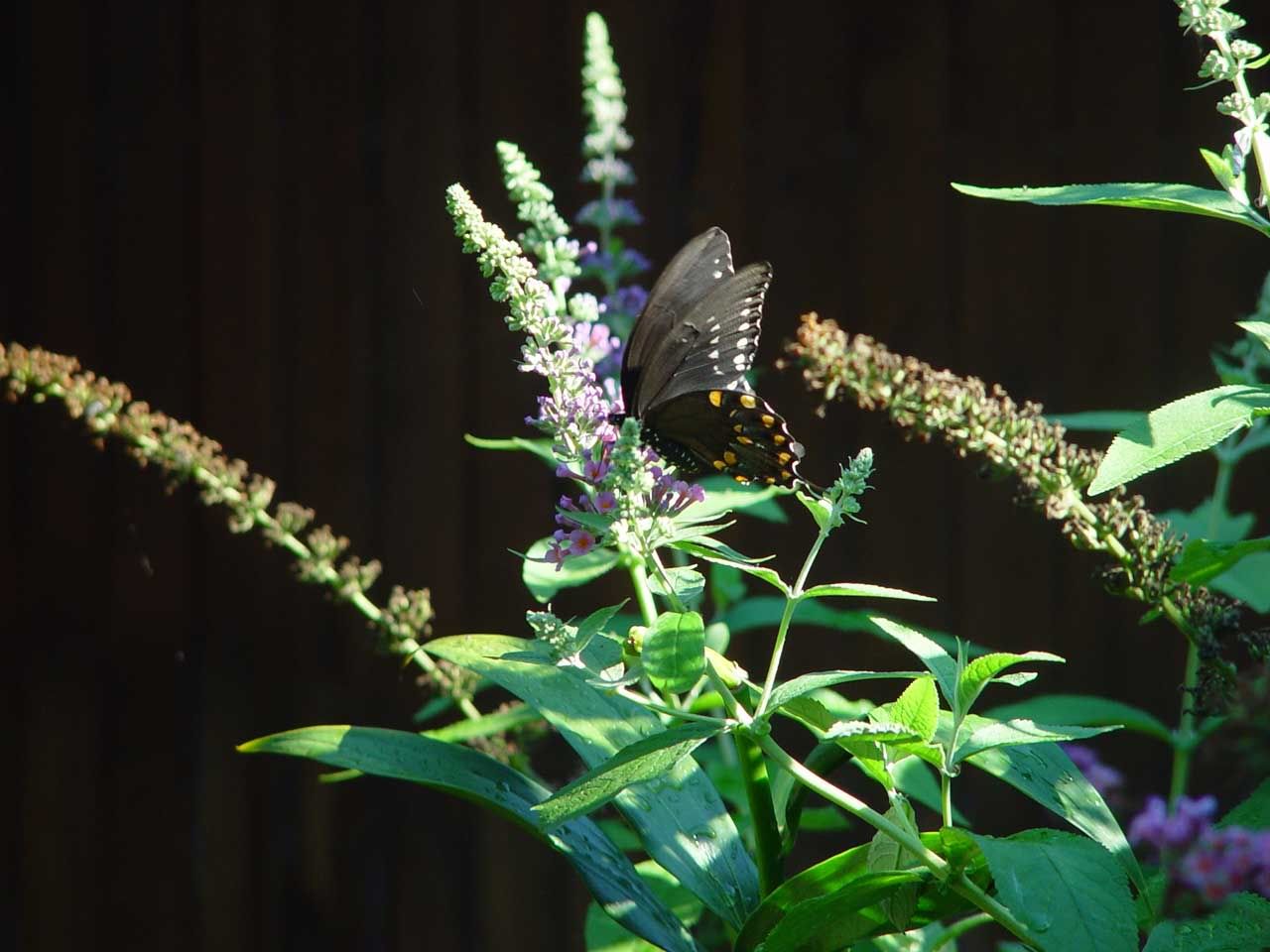
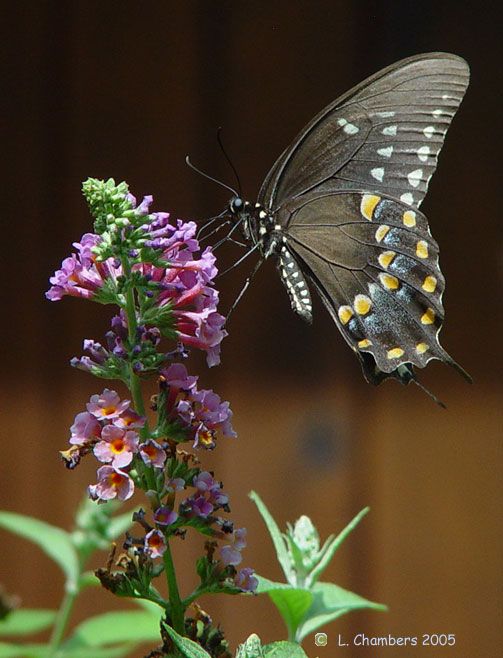
Eastern Tiger Swallowtail (aka Yellow Swallowtail).

His wings.

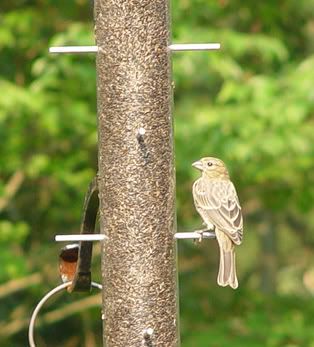
A House Finch poses for me.



 1. The bottle is STUNNING!! You see the black piece on top? You press that, and it sprays perfume upward. So I put my wrist on the black cap and pushed, and voila, I had perfume on my wrist. The bottom is round, not flat, so the bottle rocks and the aqua colored perfume looks very "marine" LOL.
I have been thinking about how to create an ocean accord. It's very hard but the only way to do it successfully seems to be by using floral combinations plus moss, and in this case, the lovely basmati rice. Narcissus is a sexy and sultry smell, and rice is a comforting smell, and moss, violet and patchouli are elemental smells. It's interesting that a photographer figured out how to make such a winning combination. I don't know who the nose was on this perfume, maybe someone else knows?
 I thought, "Aha! I have cracked the mystery of its name. I understand like no other person on earth, why it's called Chinatown." After all, other reviewers had decreed the stuff 'sweet cakey poison' (and other nauseating adjectives) -- but I, and ONLY I, had found its lemony-sweet, crisp vanilla fortune-cookie heart. And metal. Hmm. And an insane resemblance to Black Phoenix Alchemy Laboratories' perfume oil called Dragon's Milk.
 Still mentally admiring a bright and colorful street in Soho, I continued to smell the bottle and my wrist, looking for the requisite cherry blossoms (or sakura, as they say), thinking there must be more to this perfume's name than a fortune cookie. Instead, I found peach blossoms, which I also love in Clive Christian's X for Women, another heady perfume that's hard to describe. But back to Chinatown: why the strong peach blossoms? Again my mind wandered and I found myself thinking of the bright orange poppies that are blooming in my front garden. They are blindingly bright studies in delicate silk, fluttering in the cool Spring breeze. I sniff my wrist again and I detect a slight powderiness, soft and delicate, a little like a Geisha's flawlessly made-up face. Could peach blossoms be considered oriental, or was synesthesia getting the best of me?
 Nose to wrist again. I find the lemony-peony-peach flowers, and earthiness, have combined with yet another aromatic accord that is brilliantly cheerful and luxurious. As time progresses, the powderiness identifies itself as a sultry woods, gardenia and tuberose accord that bloom together like white flowers in a dense, dark night. They are as bright as a full white moon on a black sea. I begin to think of antique wooden Chinese ships at sea, loaded with silks and fragrant with spices, heading into port. And Chinatown begins to take shape in my mind, not as a part of New York City, but rather as an impression of China, and luxury, and beauty.

 What the perfumer says: Top notes of bursts of peach blossom (a mystic fruit in Chinese Mythology that Taoists consider the elixir of life. The midnotes are an intoxicating cross-cultural bouquet; Peony (known as Sho Yo, or Most Beautiful, the Chinese flower of love, luxury, and indulgence), blended with creamy-sweet gardenia (the flower Billie Holiday wore in her hair) and sultry tuberose (known in the Western World as the Mistress of the Night), and mouth-watering patchouli, which adds a spiky note to the other florals. The lingering basenotes are cardamom (an ancient spice from the East, long used as a condiment) and dark woods (recalling the scent of Chinese inlaid lacquered boxes).
 Parfum, EDP, EDT and Cologne perfume terms refer to the strength of the perfume oils. The higher the percentage of oils, the longer the lasting power. Also, the less diluted the perfume is, the better you can detect all the different oils that were used to create it. Think of it this way: a perfume that has rose, jasmine and amber might also include a hint of peony. In a parfum strength, you'd probably be able to detect the peony, whereas in the cologne, it might be diluted so much that it disappears. This very slight difference doesn't seem very important when you compare bottles by sniffing them, but when you go to wear the perfume, the alcohol/perfume oil dilutions play out very differently on the warmth and chemistry of your skin.
The iris has hundreds of botanical species and thousands of varieties, but only one is dedicated to fragrance: Iris Pallida. It takes 3 years to turn one ton of fresh Iris Pallida roots into just 50 ml (about 1.7 ounces) of iris absolute, the precious oil used in perfumery
When I bury my nose into an Iris Pallida flower (which is currently blooming in my gardens), I experience the following
- cold
- delicate, fragile
- candy sweetness
- iris
- honey
- soft subtle green (like sweetened moss)
- sugar
- hint of violet
- zero powdery - it sparkles
- sweet earthy cold clover (like the grass)
- newness, something brand new and fresh
- flowery
Notice that my nose doesn't pick up anything warm about an iris flower. This reminds me of why Isabey Gardenia, and JAR Diamond Waters are such incredibly beautiful and superior perfumes: they don't compromise their unique renditions of gardenias and carnations (respectively) by adding the ever marketable, and scent-warming vanilla, amber, or tonka bean additives. Vanilla and amber are not detected in the iris flower (or carnations or gardenias, for that matter) so there is no reason to begin to think along those lines unless of course the perfumer wants to warm and anchor the floral with this sort of basenote.
Another reason we see so much orris (chopped iris roots, not the absolute) mentioned in perfumes is because it's been used for a couple of hundred years as a perfume fixative. Even chopped up and not liquified, orris acts as a fixative to dried potpourri.
Anyway I fell madly in love with my iris flower and wanted to see how the perfumers had lately been treating the dear garden variety iris pallida, in liquid absolute form, as a top and heartnote, so I tested a few iris perfumes. Here is what I found out:
I have spritzed I Profume di Firenze, Iris di Firenze on my right arm. Odd that it smells identical to a fresh bouquet of flowers, including the dewy freshness, watery composition of petals and leaves, the greeness of roots and stems, and the sweetness of the inner iris flower. But the sweetness of the flower seems to be drowned out by the watery green stems. After awhile, that's all I smell! I give this perfume a 1 out of 10 for missing the point.
What the perfumer says: A uniquely green floral fragrance composed with the symbol of Florence - the Iris. Beautifully fresh.
On my right hand I have dotted Hermes Hiris which is beautiful, but forms an artistic rendition of an iris. It's very cubist. I smell coconut, patchouli, spices, and iris; a very complex mix, yet every note is a carefully plotted bold statement. The perfume smells like Kenzo Jungle L'Elephant to me - beloved, but not an iris perfume, per se. This perfume deserves highest honors, but for my purposes, it gets a 5 out of 10 for its lack of resemblance to an iris flower.
What the perfumer says: Hiris is a solifloral fragrance, leant a woody undertone from white iris. Hiris opens on a clear, crystalline top note of neroli, rose and coriander, which hint at the iris to come. The heart fully unveils the iris, with its sweet flowers and warm rhizomes. White and black irises mingle, muted by cedarwood and softened with a subtle feeling of linen. The base notes of ambrette, vanilla bourbon and an almond wood chord blend together for a sensuous, yet tender drydown.
On my left wrist I have Frederick Malle Iris Poudre, which went on like a hairy boar in comparison to a flower, but which has dried down to a definite resemblance to the flower - but it's a little too warm. Or maybe it's my skin that's too warm. Something is too warm about it. I think it is loaded with a vanilla bottom note, which makes the perfume more likeable to a greater market, but which removes the entire outdoorsy quality of its floral nature. This is, I suppose, a more sophisticated perfume that should be worn out in the evening, nowhere near the outdoors. Further, the long it remains on my skin, the more perfumey it becomes. I give it a 5 out of 10 and categorize it with another Frederick Malle: Lipstick Rose, which is something a diva must wear to the opera.
What the perfumer says: Iris expresses raw classical beauty. Tonka bean, musk and vanilla bring softness and warmth, while the base of sandalwood and vetiver adds a melodious resonance. If Pierre Bourdon's IRIS POUDRE were a garment, it would be a cashmere sweater - classic but personal, appropriate for most occasions, something one never tires of. It is a grand floral aldehydic.
Maitre Perfumer et Gantier Fleur d'Iris, on the back of my left hand, is so subtle, my nose has trouble detecting it . . . there it is! It smells like freshly mowed lawn, iris, candy sweetness, a hint of violet, a summer's day. There is even a tiny green quality like one single lily of the valley bellflower. It is not powdery and it's not sharp either. It's a well blended floral. In fact, I think this is very close to the real thing, but it completely lacks the honey, clover, and freshness of the flower, leaving the perfume in a sort of a dead zone. This is a nice perfume, but nothing to write home about. Funny how close it is to the real flower, but completely missing what is most exciting about the real flower. I give this a 6 out of 10 for being a close but boring rendition of iris pallida.
What the perfumer says: It is the association of a green note on the background of Iris root. Young note. It suits well the active and sporty woman and the one that wants a perfume that holds well while retaining a certain discretion.
Maitre Perfumeur et Gantier Iris Bleu Gris (for men)- This edt goes on just like freshly mowed lawn, a calming soft and balsamic green. Then a lovely candy sweetness begins to surface and the scent of the true iris pushes through. There is an uncanny likeness to the real flower but the perfume isn't quite as fresh, as churchy fresh, as the real thing. (You know how a church smells when you first walk in? All the flowers and incense at the same time? That is a real flower smell, like the iris in front of my nose.) Iris Bleu Gris is incensy in that fresh-flowery kind of way, a delicate sugary floral with that ethereal violet note which makes the flower slightly earthy without being funereal. The freshness seems to be a leathery note, which is smooth and yet has a newness to it. I'm going to give Iris Bleu Gris a 7 out of 10 for achieving the smell of a real iris pallida flower.
What the perfumer says: The old Iris root gives an essence, which associated with rare essential oils of wood and aromatic plants, translates into a warm and original fragrance. This blend linked to a leather note makes it the perfume of the tuxedo-wearing man, as well as the speed-loving motorcyclist. Worn at 18 as well as at 50, this eau de toilette is the travel perfume whilst retaining a certain romanticism in its seduction.
Serge Lutens Iris Silver Mist is a smooth cedary perfume with a cinnamon kick. The iris is right there but the rest of the notes kick it up a few notches into a screamingly woody cologne. This is the equivalent of a Mexican fiesta with sequins, stomping heels, and wild mustachioed men playing trumpets all night. It is also so velvety as to resemble a blast of cold incensed air hitting you in the face when you first walk into a cathedral. Later, after it calms down a bit, it turns soapy and loses some of its edge. I give this an 8 out of 10 for being a very exciting and imaginative iris perfume.
The notes: iris roots, cedar, sandalwood, incense, white amber, musk, Chinese benzoin balsam
The Different Company Bois d'Iris provides the sweetness of a real iris, including a honey accord, but the woods make it soft and smooth rather than refreshing and dewy. It is the most beautifully blended of all the perfumes I'm testing today, so that all of its notes present one unified accord. This is a Van Gogh painting of dark irises deep into a sunlit woods; deeply iris and earthy and just loaded with bold strokes of color. I'm going to give this a 10 out of 10 for accurately presenting iris pallida and framing it in woods rather than mixing with woods. It has a je ne sais quoi quality that sets it very far apart from all the other iris perfumes and makes it memorable, unique, and utterly stunning while also remaining closely true to the flower itself. This is without doubt, my favorite of all the iris perfumes, and quite possibly my favorite of all perfumes.
What the perfumer says: The Iris Pallida, the most aromatic of its kind, grows exclusively in this arid, rocky mountain side (of Tuscany), yet where the soil is mild. Unlike the osmanthus flower whose epidermis cells secrete the essential oil, the iris conceals its olfactory wonders within its roots. Olfactory note: Woody, velvety, sweet and green, refind. Main components: iris Pallida (aka Iris Florentina), vetiver, bergamote, cedar wood, narcissus, geranium, musk.


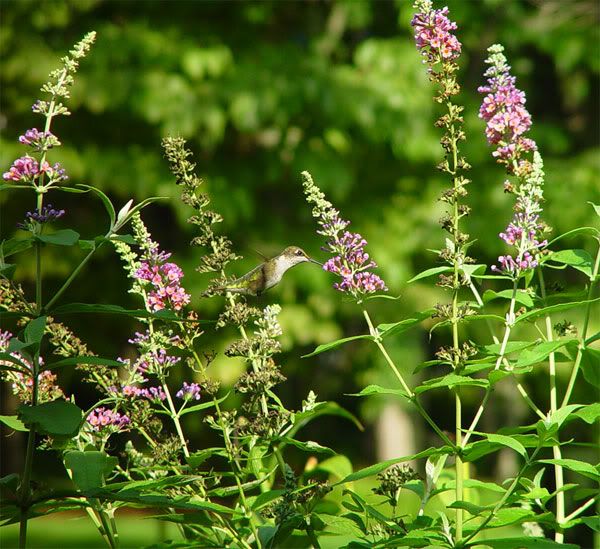
When I bought my bottle of The Different Company's perfume called Divine Bergamote, I nearly keeled over from joy because I had finally found, after a twenty year search, what I thought was an authentic Bergamot perfume. This perfume nearly perfectly duplicates those wondrous roots and stems of my favorite garden plant, monarda didyma 'Violet Queen' which in full bloom, seems to attract all the hummingbirds in the entire tri-state area. I love handling this plant, roots, runners, flowers, stems, leaves - everything about it smells delightfully perfumed. But when I tried to research Monardas, I ran into a problem: many plants are called Bee Balm, Balm, or Bergamot; and the local flower nursery called an entirely different, rough-leaved shade plant with ugly sour lemon scented leaves "Balm" or "Verbena." Yet I knew my delicate woody "Verbena" at home was a big bush with toothy, fine, and sweetly lemon-scented leaves.
Wearing Divine Bergamote perfume, and clutching one of my precious dried Lemon Verbena leaves, I found myself researching which perfumes might be made with what bergamots. Are they made with the sweet-earthy-citrus smell of monarda didyma or the wild mountain-grown monarda fistulosa? Or are they made with the sweet citrus-earthy smell of Citrus aurantium Bergamia from Calabria, Italy? The perfume houses appear to be guarding this information to some degree because after extensive research, I can find very few clues as to which is which. And will the real verbena please stand up? Is verbena a plant, or a tree?
I was never able to uncover the bergamots used in perfumes, whether they are monarda didymas or citrus trees from Italy.
However I present to you for your thoughts, a few plant descriptions to get you thinking. I will continue my research -- I swear I will figure out which perfumes contain which balm, bergamot, verbena and bee balm!
Bergamot, aka Citrus aurantium var. bergamia
Oil of Bergamot is drawn from the peel of the Bergamot Orange, aka Citrus aurantium var. bergamia, which is grown in Calabria, Italy for commercial purposes. Bergamot oil from this Calabrian tree is used to flavor Earl Grey tea.Bee Balm, aka Bergamot, aka Monarda fistulosa
Bee Balm, aka Bergamot, aka Monarda didyma
Wild Bergamot (Monarda fistulosa) is often called Bergamot or Bee Balm and there are many forms and cultivars of this flowering plant from the mint family. The cultivated form is known as Mondarda didyma, also known as Oswego Tea or Bee Balm. This herb was originally popular among early American colonists as a tea substitute. The entire plant is fragrant from runner-like roots to square stems to flower petals. Its aromatic fragrance is a result of the chemicals thymol (of which
Monarda didyma is a commercial source) and the oregano-scented carvacrol. Its spicy notes come from eucalyptol and cymeme. Frequently a small flower appears out of the top of the one below - which is a habit of many herbs of the mint family.
A species sold as Lemon Mint is really Western Balm, Monardella odoratissima. Lemon Mint is more of an annual, properly called Monarda citriodora, with pink flowers that have purple spots. It's very rarely available, but also has a strong citrus scent.Bergamot, aka Eau de Cologne mint
Mentha x piperita citrata is variously known as bergamot, Eau de Cologne, or orange mint. The smooth, broad, oval leaves of this small bushy plant have a totally delicious, soothing fragrance, and are good as an infusion for herb tea. This plant has tiny clumps of white flowers and square stems (as with all mints).Lemon Balm, aka Verbena
Lemon Balm, Melissa officinalis, (often called "Balm," "Lemon Balm," "Melissa," or "Verbena"), is a low bushy plant with broad serrated leaves. It contains two lemon-scented chemicals: citral and citronellal. Lemon Balm has been used by generations of beekeepers to entice swarms into their new homes, and once there to remain quietly - knowing how touchy bees can be, the scent must have a soothing quality. Melissa means bee. Balm is a hardy, perennial herb, growing to 36 inches, with crinkly leaves and insignificant white flowers on one side of the square stems.Lemon Verbena
Lemon Verbena, (Lippia citriodora, synonymous with Aloysia triphylla), is usually called "Verbena," or "Lemon scented Verbena." This is a three to five foot tall bush with woody branches, which can be trained into a tree. The bare stems are lemon scented, and the leaves are a heady sweet lemon fragrance that strongly resembles lemon blossoms. This plant is not hardy but can be overwintered indoors in a bright sunny spot. The scent is sharp, sweet, and refreshing, and perfect for potpourri or tea; or dry the leaves and use them as bookmarks. The leaves also freeze in ice cubes and make perfect additions to iced tea. The chemical contributions from its oil to flavor and scent include hydrosol, citral, myrcene and citronellal.


